



Scholarships
15 Funded PhD Positions in Battery Technology in Europe: ZEST 2027
Explore 15 funded ZEST battery-research PhDs in Europe for 2027. Check projects, eligibility, gross allowances, documents and the conflicting deadline notices before applying.
By Ali Zubair•October 23, 2026
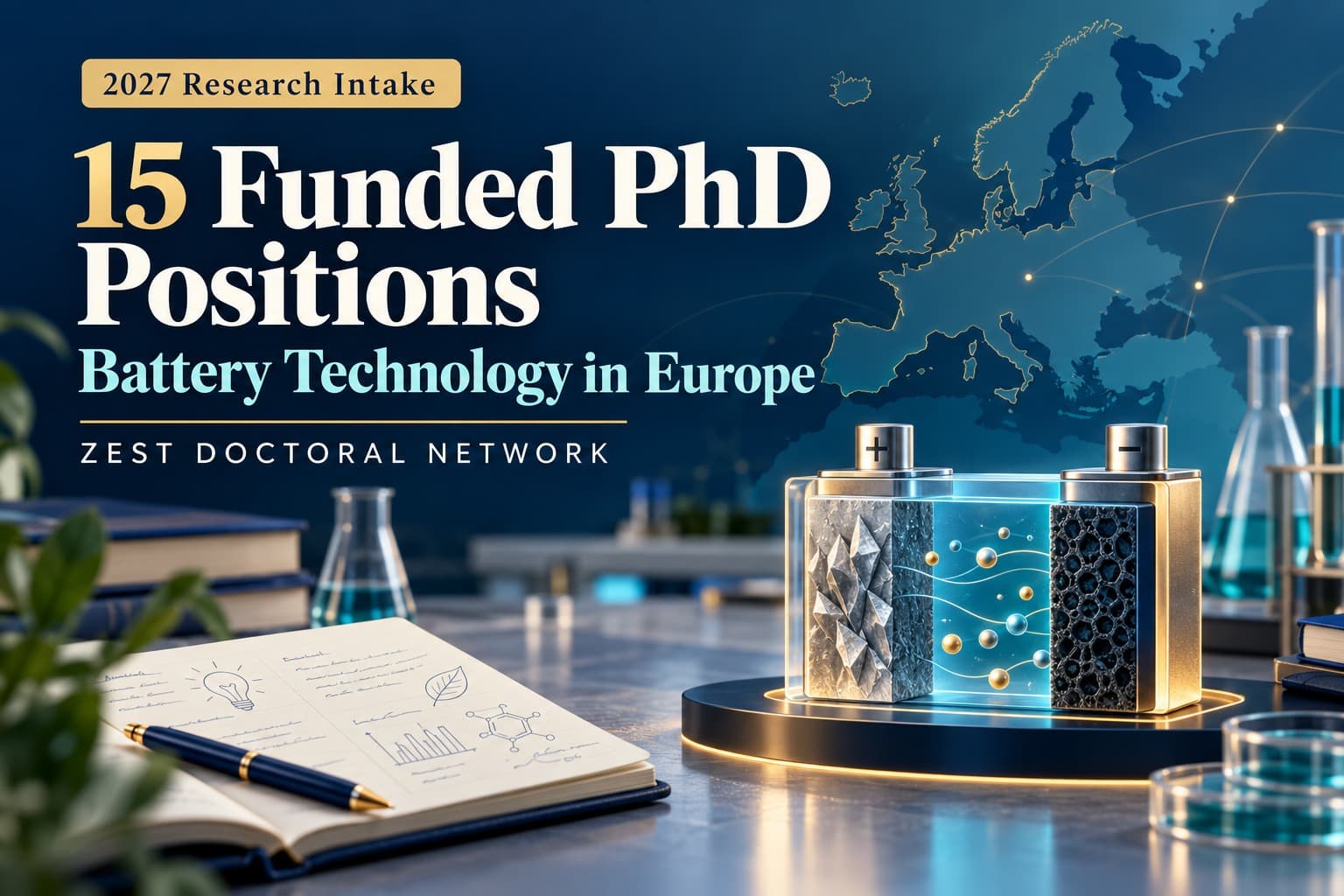
Interested in battery materials, electrochemistry or sustainable energy storage? The ZEST Doctoral Network is recruiting 15 doctoral candidates for research on zinc-based battery technology across Europe, with targeted contract starts during April–November 2027.
These are funded research positions within a Horizon Europe Marie Skłodowska-Curie Actions Doctoral Network. Your first task is to identify the project that matches your academic training, laboratory experience and research interests.
APPLICATION STATUS AND DEADLINE: READ THIS FIRST
Checked on 21 October 2026: the official ZEST recruitment portal lists 15 open positions. The DC8 vacancy page gives 15 December 2026 as its closing date, matching the key-dates section of the project’s recruitment document and the recent EURAXESS news announcement.
However, the recruitment document’s application paragraph still gives 27 November 2026. The EURAXESS vacancy supplied with this announcement also contains that earlier date and an “expired” label. These official sources are not fully consistent.
Check the current page for your chosen position and confirm its deadline with ZEST before relying on the later date. Where possible, aim to finish before the earlier date. Do not interpret the inconsistent EURAXESS label as proof that the separate recruitment portal is closed.
Browse the official application portal:
https://recruitment.dn-zest.eu/en/jobs
WHAT IS THE ZEST DOCTORAL NETWORK?
ZEST stands for European Doctoral Network on Zinc Energy Storage Technology. Its projects investigate battery materials, components and processes, with an emphasis on performance, safety and sustainability.
The research is organised around four areas:
• Water-based zinc-ion batteries.
• Zinc-air battery systems.
• Zinc-ion batteries using alternative electrolytes.
• Battery recycling and circularity.
For applicants, the practical point is that “battery technology” covers several different kinds of research. A project focused on polymer membranes will need a different explanation of your preparation from a project focused on recycling or sustainability assessment.
WHERE ARE THE 15 PHD POSITIONS?
The recruitment portal groups the projects across five host organisations. The descriptions below are shortened topic summaries; open each project page for its full requirements.
Germany — Universität Bremen
• DC1: Electrode materials for rechargeable aqueous zinc-ion batteries.
• DC4: Protective, bio-inspired battery membranes.
• DC9: Water-in-salt electrolyte development.
Belgium — KU Leuven
• DC3: Electrode interfaces and battery performance.
• DC7: Zinc-air batteries for mobile hybrid energy systems.
• DC8: Hydrogel electrolytes for zinc-ion batteries.
Sweden — RISE Research Institute of Sweden
• DC2: Manganese-oxide cathode development.
• DC12: Cellulose-based battery separators.
• DC15: Recovery and reuse of zinc–manganese dioxide battery materials.
Italy — Sapienza Università di Roma
• DC6: Materials and designs for zinc-air batteries.
• DC10: Deep-eutectic solvent electrolytes.
• DC13: Sustainability assessment of new battery materials.
United Kingdom — University College London
• DC5: Zinc-air cathode interfaces.
• DC11: Testing alternative electrolytes in complete battery systems.
• DC14: Sustainable battery binders.
Project descriptions:
https://dn-zest.eu/open-positions/
FUNDING, SALARY AND CONTRACT LENGTH
The advertised MSCA funding period is 36 months. The vacancy describes indicative monthly gross allowances of approximately €4,010 for living costs and €710 for mobility, plus €660 for family support where applicable.
These figures are not a guaranteed take-home salary. The living allowance is subject to the applicable country correction factor, and national tax and social-security deductions affect the final employment package. The recruiting host confirms the actual contract and net pay.
Training includes network activities, secondments and opportunities to work with academic and industry partners. Any support beyond the initial 36 months depends on the host and local arrangements; it should not be assumed.
Before accepting an offer, ask for the contract details, applicable fees and relocation requirements. Build a budget using the actual host location and confirmed pay, rather than treating the advertised gross figures as money available after deductions.
WHO SHOULD APPLY?
Applicants need a relevant master’s qualification or equivalent and must not already hold a doctoral degree at recruitment. The required academic background differs between projects: examples include chemistry, chemical engineering, materials science, physics and related engineering fields.
Read the individual profile closely. DC1 at Bremen, for example, lists chemical engineering or chemistry and relevant synthesis and electrochemistry interests. DC15 at RISE focuses on battery recycling, with interests including electrochemistry and metal-recovery processes.
The recruitment document also welcomes master’s students expecting to graduate in the coming months, using the transcripts already available. If this applies to you, confirm the required completion date with the host before making plans.
THE MSCA MOBILITY RULE
The published rule requires international mobility. Applicants must generally not have lived or carried out their main work or studies in the recruiting country for more than 12 months during the three years immediately before recruitment. Short holiday stays are excluded.
Check your dates against the country of the position you want. Studying in one European country does not automatically answer your eligibility for a position in another. Prepare an accurate record of residence, studies and work, and ask the host to clarify any uncertain period.
Applicants also need strong written and spoken English. Follow the host’s instructions about acceptable evidence; do not assume an automatic test exemption. Some positions have additional knowledge-transfer or export-control conditions that require individual confirmation.
DOCUMENTS AND APPLICATION PREPARATION
The call requests an obligatory Europass-format CV, a motivation letter and bachelor’s and master’s transcripts. Applicants can select up to three doctoral projects and rank their preferences.
Use your CV to make relevant evidence easy to find. Include the methods you have actually used, your thesis contribution, laboratory or modelling experience, and any relevant research output. Describe your role accurately instead of listing techniques you cannot explain in an interview.
In the motivation letter, connect your background to the selected project. Explain which problem interests you, what preparation you bring and which skills you want to develop. A clear explanation of that connection is more useful than general praise for studying in Europe.
Follow the current portal checklist as well as the general call. The DC8 page, for example, currently lists short video answers, interview booking and document uploads as application components. Other project instructions should be checked directly.
HOW TO APPLY
1. Read the project descriptions and shortlist roles that fit your training.
2. Check the academic profile, mobility rule and any project-specific conditions.
3. Confirm the current closing date, given the conflicting dates in the published material.
4. Prepare your Europass CV, motivation letter, transcripts and any additional items requested by the portal.
5. Follow registration and application instructions on the official recruitment platform, ranking up to three projects as permitted.
6. Review every submission and retain its confirmation. Continue checking your own account and email for assessment instructions.
The published process includes scientific assessment, a presentation and interviews for shortlisted candidates. Recruitment-event dates also differ between sections of the recruitment document, so follow the current invitation rather than booking travel from an older paragraph.
OFFICIAL VACANCY AND APPLICATION SOURCES
EURAXESS vacancy:
https://euraxess.ec.europa.eu/jobs/469736
ZEST project and project descriptions:
https://dn-zest.eu/
https://dn-zest.eu/open-positions/
Official recruitment platform:
https://recruitment.dn-zest.eu/en/jobs
Recruitment procedure and eligibility document:
https://dn-zest.eu/MSCA-DN-ZEST-Recruitment-Procedure.pdf
FOLLOW LEARN WITH ALI ZUBAIR
Follow my official channels for scholarship updates, admission guidance and application videos.
WhatsApp channel — Learn With Ali Zubair:
https://whatsapp.com/channel/0029VaDEqA84inou4jHNQL0Z
YouTube — Learn With Ali Zubair:
https://youtube.com/@learnwithalizubair?si=q5vQmqucDjQ3tT6S
Facebook:
https://www.facebook.com/Mathguru145/
Instagram:
https://www.instagram.com/learnwithalizubair/
TikTok:
https://www.tiktok.com/@learnwith.alizubair
Website — Study With Ali Zubair:
https://www.studywithalizubair.com/