



Study Abroad
University of Pisa Admission 2027–28: Courses, Fees and Scholarships
Plan your University of Pisa application for 2027–28 with detailed guidance on courses, entry requirements, tuition fees, DSU scholarships, housing and visas.
By Ali Zubair•October 19, 2026
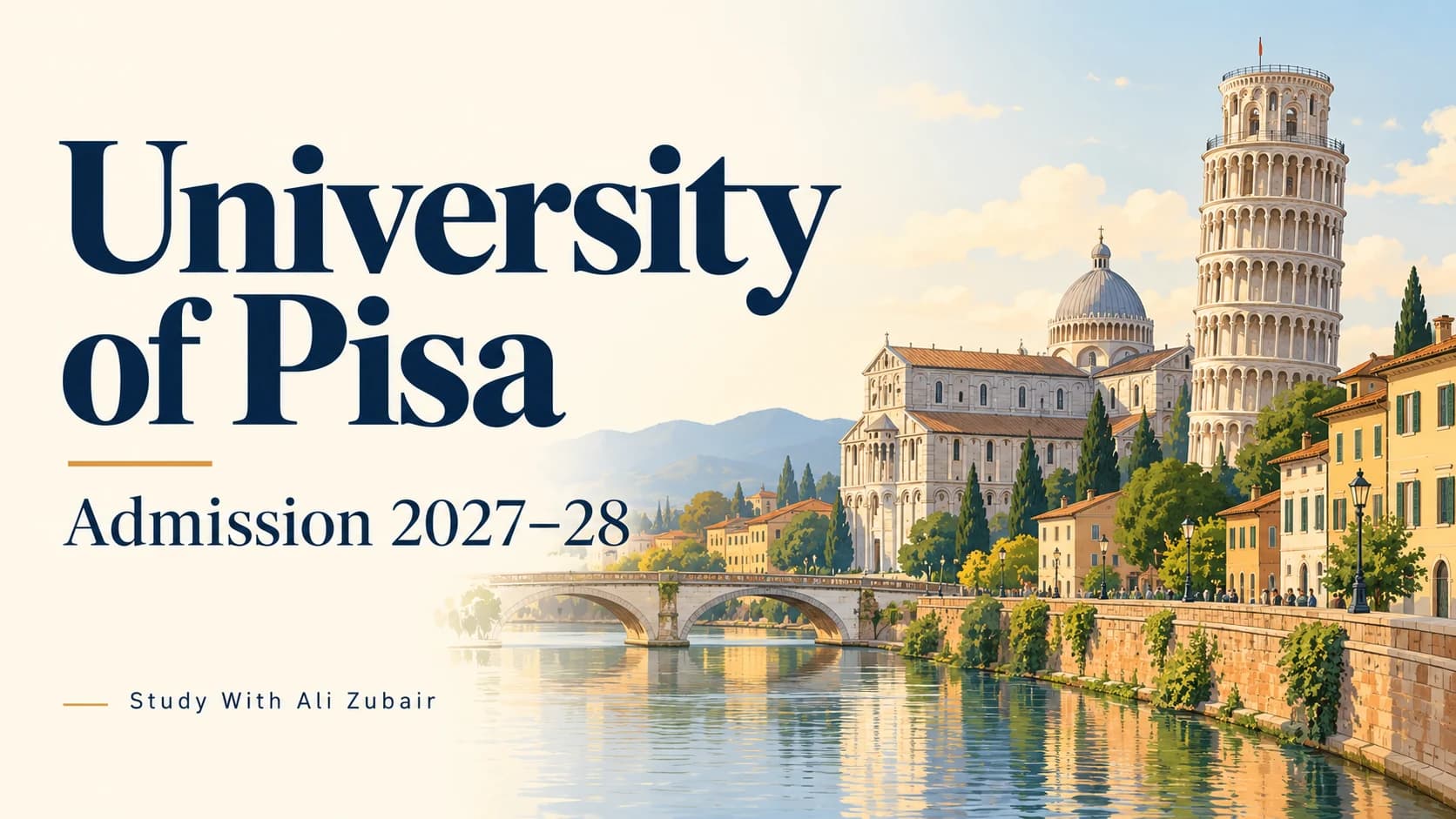
University of Pisa admission for 2027–28 starts with choosing the right course and understanding which application route applies to you. The degree application, university registration, scholarship request and study-visa process have separate requirements. Completing one does not complete the others.
Pisa is worth considering if you want to study in Italy in a city where university life extends across different departments and neighbourhoods. Before you decide, compare the curriculum, language requirements and realistic cost of moving. A course that fits your academic background is a better starting point than a promise of easy admission or guaranteed funding.
What is confirmed for the 2027–28 intake?
As of October 2026, the official admissions and fee pages reviewed for this guide still display 2026–27 information. Use those details to prepare, then follow the 2027–28 call for your chosen programme when it is published. An old deadline is not a reliable prediction of the next one.
This matters particularly for English-taught master’s degrees: Pisa’s published schedule shows different deadlines by programme and applicant category. The final enrolment date can also be much later than the deadline to apply for academic assessment.
Create a tracker with separate entries for course selection, tests, the university application, DSU Toscana, Universitaly and final enrolment. Record the Italian deadline time as well as the date.
Which University of Pisa courses are taught in English?
Pisa’s current English-language catalogue includes the Bachelor’s Degree in Management for Business and Economics. At master’s level, examples include:
- Economics.
- Computer Science.
- Data Science and Business Informatics.
- Artificial Intelligence and Data Engineering.
- Computer Engineering.
- Cybersecurity.
- Neuroscience.
- Materials and Nanotechnology.
These are examples from the current offering, not a guarantee that every course will have identical rules or places in 2027–28. Read the programme website and study plan before paying an application fee.
For a technical master’s, compare your previous mathematics, programming and subject modules with the stated prerequisites. For Economics, look at the balance of economic theory, statistics and mathematical preparation. Similar degree titles can hide very different academic expectations.
Also check the teaching location. Choosing accommodation around a landmark or the railway station makes little sense if it creates a difficult daily journey to your department.
Bachelor’s admission: qualifications and entrance tests
Pisa generally requires at least 12 years of schooling and a qualification that grants access to higher education in the education system where it was awarded. If your schooling is shorter or your qualification follows an unusual route, request an assessment rather than assuming it will be accepted.
Undergraduate courses can have open or regulated admission. Open-admission courses may still assess initial preparation; the assessment can lead to additional learning requirements. Regulated admission involves competition for a defined number of places.
Read the actual course call for the test, registration platform, accepted results and selection method. Do not book a test solely because another Italian university accepts it. For non-EU applicants requiring a visa, check the reserved-place rules and whether Universitaly must be completed by the course’s selection deadline.
Master’s admission: subject fit matters
A master’s normally requires a suitable first-cycle university qualification. The programme decides whether your earlier studies provide the necessary foundation and how it assesses your preparation. Avoid treating one CGPA figure as a minimum for the entire university.
Pisa’s MSc Economics provides a useful example. Its current requirements identify preparation in economics, statistics and mathematical methods. For applicants with a non-Italian bachelor’s degree, the committee examines course content and the overall academic record. Meeting minimum curricular requirements does not guarantee admission.
Prepare module descriptions if your transcript uses broad titles such as “Quantitative Methods” or “Business Studies.” They help explain what you actually covered. Present your grading scale clearly, and use your motivation statement to connect previous work with specific parts of the programme.
If you are changing fields, identify the gaps before applying. Ask whether missing preparation can be remedied and whether the programme permits conditional admission. The committee’s written decision is more useful than an informal assurance from an applicant group.
IELTS, English evidence and Italian requirements
There is no safe university-wide answer to “Can I apply without IELTS?” Check both the course’s academic requirements and the language evidence relevant to your visa application.
For example, MSc Economics currently specifies at least B2 English and says alternative evidence may be accepted in particular cases. That should not be read as an automatic medium-of-instruction exemption for every Pisa course or as permission to ignore consular requirements.
Pisa’s Language Centre also publishes a B2 English assessment for eligible non-EU applicants who need evidence for visa purposes. Its available sessions, eligibility and fees must be checked separately; a past test date does not establish a 2027 timetable.
For Italian-taught programmes, visa-requiring applicants should check the university’s Italian-language assessment and accepted B2 evidence or exemptions. Even when your degree is taught in English, learning practical Italian will make housing, appointments and daily life easier.
Which application portal should you use?
Pisa uses several systems. Follow the link in your programme’s current call rather than opening every portal and submitting the same information everywhere.
- English-taught master’s academic applications: most programmes use applymscenglish.unipi.it. Pisa lists exceptions, including separate routes for Space Engineering and Materials and Nanotechnology.
- Alice: the university’s student portal, used for procedures including undergraduate test registration and university enrolment.
- Universitaly: pre-enrolment for applicants who require a study visa.
- DSU Toscana Sportello Studente: the separate application for regional study benefits.
An Alice account by itself does not establish admission to an English-taught master’s. Equally, an academic offer does not automatically create a DSU scholarship application.
How to apply: a practical sequence
1. Identify your degree and applicant category. Citizenship, residence status and where you obtained your qualification can affect the procedure.
2. Download the correct academic-year call. Check academic prerequisites, language evidence, required documents, selection stages and deadlines.
3. Prepare readable files and complete the application in the specified portal. Use an email account you can access throughout the process.
4. Pay any charge required by that call. As a current reference, MSc Economics lists €30 per application for applicants holding foreign qualifications in 2026–27. Confirm the next intake’s fee and conditions before paying.
5. Submit and retain the acknowledgement. Completing a form or making a payment is not a substitute for checking that the application has been submitted.
6. Monitor the portal and email. Respond to requests for clarification and follow any interview or assessment instructions.
7. After a decision, read every condition in the offer and start the relevant enrolment and visa steps.
Before submission, have someone check that your course name, qualification details and uploaded files agree. A careful final review can prevent an avoidable correction request close to the deadline.
Document checklist for international applicants
Prepare the following, then match the folder to your course’s exact instructions:
- Valid passport or other identity document accepted for your category.
- School-leaving qualification for undergraduate admission, or bachelor’s qualification for master’s admission.
- Academic transcripts and an explanation of the grading system.
- Module descriptions or syllabus, where needed for academic evaluation.
- Accepted language evidence.
- CV, statement of purpose and references, if the programme requests them.
- Documents needed for qualification recognition and final enrolment.
Do not assume that the first application upload is the final document check. Translation, authentication and recognition requirements can differ between academic evaluation, university enrolment and the consulate. Confirm which Declaration of Value, CIMEA or other evidence applies before ordering a paid service.
Keep complete scans and originals organised. If your name differs across documents, resolve that issue early and ask what supporting evidence the university requires.
University of Pisa tuition fees and reductions
For 2026–27, Pisa publishes a maximum annual all-inclusive tuition contribution of €2,900 for students within the standard programme duration. Regional tax and stamp duty are additional charges. These are current reference figures, not confirmed prices for 2027–28.
The published country-based reduction schedule lists these annual tuition amounts:
- Low-income country category: €290.
- Lower-middle-income category: €580.
- Upper-middle-income category: €1,160.
- High-income category: €2,900.
The same page lists a €140 regional tax and €16 stamp duty. Check the applicable country table, personal eligibility and next year’s regulations before calculating your bill. These categories describe the published fee system; they do not establish your individual scholarship entitlement.
Pisa also offers an income-based route using ISEEU Parificato. Its current instructions require an application through Alice and submission of the certificate to the university. Check the new procedure and deadline rather than assuming a low household income automatically changes the fee.
Budget application charges, translations, qualification checks and travel separately. Read the instalment rules so you know which payments fall before and after arrival.
DSU Toscana scholarships: what students should know
DSU Toscana and the University of Pisa are separate organisations. You must apply for regional benefits through Sportello Studente; a university admission application does not enter you into the scholarship competition.
The current DSU information describes support that can include tuition exemption, meals, a monetary allowance and accommodation or housing support for eligible students living away from home. The award and its components depend on the call and your assessed circumstances. A residence place should not be treated as an immediate housing guarantee.
For families abroad, DSU’s guidance covers household composition, income, property and financial assets. Start identifying the issuing authorities early. The relevant call determines reference years, translations, legalisation and delivery requirements; uploading a scan may not complete the process for original documents.
Check prior-study restrictions too. Pisa’s guidance says applicants who already hold a qualification at the same level are not eligible for the scholarship for that level. Benefits are awarded for one academic year, and continuing students must check renewal and academic-progress conditions.
Until the 2027–28 call appears, do not reuse a previous scholarship deadline or advertised award amount as a promise for your intake.
Accommodation and living costs in Pisa
Pisa’s accommodation page explains that the university does not have a single residential campus. It currently quotes around €300–€350 monthly for a room, with utilities and possible condominium charges extra. Treat this as an indicative university estimate, not a guaranteed 2027 rental price. Compare live listings for your actual study period.
The university also notes that deposits commonly equal two or three months’ rent. For illustration, a €350 room with a two-month deposit needs €1,050 for the deposit and first month alone, before bills, travel or temporary accommodation.
Ask the landlord what is included, how long the contract lasts, how the deposit is returned and whether the room matches the photographs. Check the journey to your department and the evening transport options. Pisa links students to housing-search services including DSU’s CercoAlloggio.
Build a monthly budget for rent, utilities, food, transport, phone and personal expenses. Keep an additional arrival reserve for the deposit, initial payments and documents. Your plan should still work if scholarship services or payments begin later than expected.
Universitaly, the study visa and final enrolment
Applicants who need a study visa must follow Pisa’s Universitaly pre-enrolment procedure for their chosen programme. For an English-taught master’s, the current instructions require the programme’s admission letter for validation.
Once the university has validated the application, follow the competent Italian diplomatic office’s instructions for the Type D study visa. An offer or validated pre-enrolment does not guarantee a visa or a consular appointment. Check the requirements for your country of residence and leave time for corrections.
Final university enrolment remains a separate step. Pisa’s current English-master’s guidance includes qualification and transcript checks, the admission letter, official tax code and evidence relating to the residence-permit application. Follow the instructions issued for your intake and retain payment and submission receipts.
Frequently asked questions
Is there one University of Pisa admission deadline?
No. Programmes and applicant categories can have different deadlines. Academic assessment, entrance tests, Universitaly, scholarships and enrolment must each be tracked separately.
Can a final-year undergraduate apply for a master’s?
Some programmes permit this. MSc Economics currently accepts applications from students expecting to graduate before enrolment closes, but enrolment requires completion of the degree. Confirm the 2027–28 course rule and any condition in your offer.
Does a low tuition fee mean I have won a scholarship?
No. A tuition reduction and a DSU award are different decisions. Check what each covers and which documents and applications are required.
Can I submit a medium-of-instruction letter instead of IELTS?
Only if the relevant course accepts that evidence. Check the visa-related language requirements separately and keep written clarification where the rules are unclear.
What should I prepare before applications open?
Shortlist courses that match your transcript, collect module descriptions, resolve language-evidence questions and obtain realistic housing quotations. Then build your document and deadline tracker around the new call.
Official pages to keep handy
International admissions and applicant categories: https://www.unipi.it/en/education/registration/enrolment-and-registration/enrolment-for-international-students/
English-taught degree catalogue: https://www.unipi.it/en/international-students/programmes-taught-in-english/degree-programmes-held-in-english/
English-master’s application portal: https://applymscenglish.unipi.it/
Alice student portal: https://www.studenti.unipi.it/
Tuition reductions: https://www.unipi.it/en/education/registration/enrolment-and-registration/enrolment-for-international-students/reduction-of-tuition-fees/
DSU Toscana scholarships: https://www.dsu.toscana.it/borsa-di-studio
For Universitaly questions, Pisa lists universitaly@unipi.it. For course eligibility, contact the programme’s admissions office; for DSU documents and benefits, use DSU’s own assistance channel.
Compare your options in Italy
Italy admission planning: https://www.studywithalizubair.com/blog/italy-university-admission-2027-28
University of Pavia admission guide: https://www.studywithalizubair.com/blog/university-of-pavia-admission-2027-28